Blog
I bought my Xbox 360 just after Christmas 2006 – £300 for the console with two wireless controllers, Project Gotham 3 and the first Gears of War.
Since then it’s been painted, it’s red ringed and taken a holiday to Frankfurt where it was repaired over Christmas 2009, lived with me in five different houses, and generally been run in to the ground; but although all the internals were replaced with the RRoD repair in 2009, the hard drive was still the original 20Gb unit it arrived with.
Until the last couple of years this hasn’t been a problem, but now it’s annoying.
Continue reading “Upgrading an Xbox 360 hard drive, the cheapskate way”Hello friends, today I want to talk about board games.
Well, not really, but let’s briefly discuss that I made one.
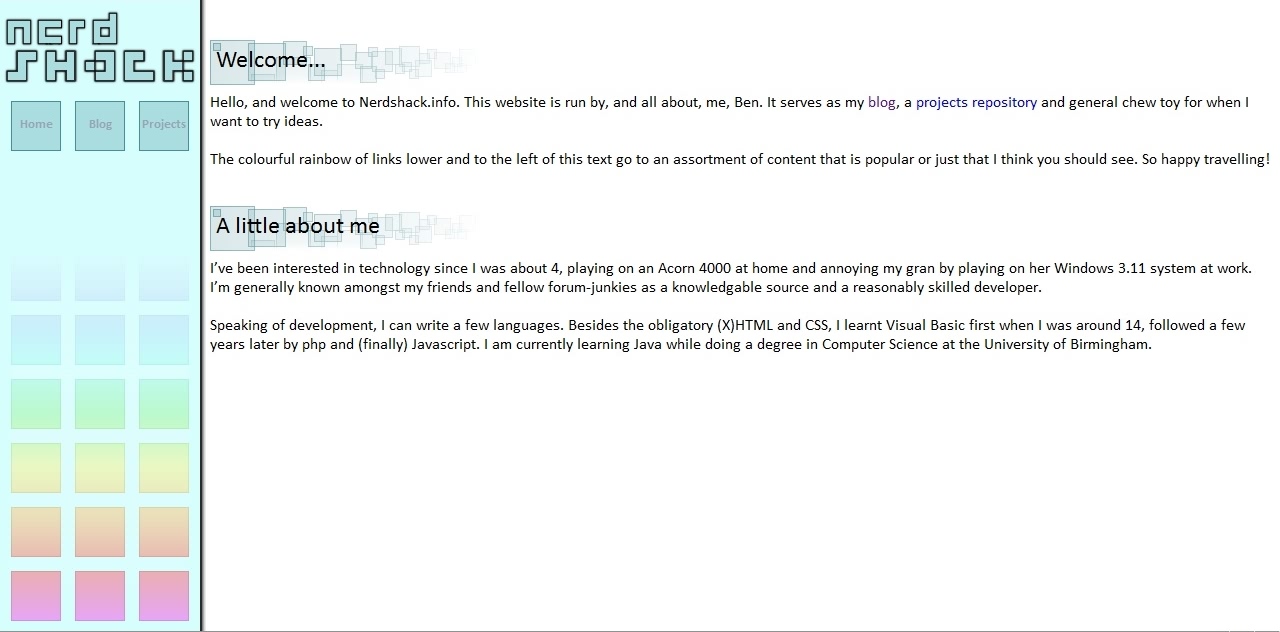
Before the current Nerdshack, and before the previous Nerdshack, there was the original Nerdshack – the same site really, blog, portfolio and random drivel, but in a more designed shell.
I recently found this single screenshot of the old design and figured I’d publish it for posterity. I still like it – those boxy headline backgrounds were based on the window frames from the Watercolour theme in Windows Whistler (XP) builds 2410-2419, and the boxy layout of the sidebar complimented it nicely.
In the final iteration, the lower boxes on the sidebar contained links to recent blog posts, and clicking any link in to the blog triggered a smooth transition to the identically laid out but much darker design of the blog. I’m currently investigating building a similar theme for the current site – the grey is nice but it is a bit depressing after a while!
Hopefully this week I’ll be recieving LEDs and some replacement chips for ones that were fried in my first attempt and I can finish off my new Xbox mod. I pulled it apart and figured out all these problems over the weekend, and fixed a few small glitches while I was there, as well as finally switching the ROL lights in my 360 to blue so they match the Xbox1.
Here’s a quick photo of my colour matched beauties.

I’ve spent a lot of my downtime the last few days crawling through C++ in a debugger and gathering crash data via adb from my tablet with the aim of fixing threading bugs! A few core classes lightly stripped down and occasionally rewritten, a few things jiggled about and we have something that’s stable [on Windows].
I left several copies of this code running the other day as a test — none explicitly crashed, although there are persistent memory leak issues over time which eventually lead to a freeze on the second thread, which does a lot of the work.
But in my testing all the sessions ran for at least half an hour at double speed (only a debug option right now, sorry), notching up an impressive health of over -5000. Besides the threading fixes everything else is basically the same as in the previous demo, so still lots of unfinished/unfixed/placeholder content and code.
Progress with Tower Defence has been slow recently with moving and the general disruption that brings, but the other day I did manage to settle in and resolve a few long standing nasty bugs which brings the game to a much more playable level. As such, I felt it might be prudent to make a demo available so people can actually try this thing out themselves rather than watching my boring videos.
I’m a long way from guaranteeing it’s crash free. There are also bugs galore (see full release notes after the break), and a few things are disabled for being either half implemented or inconsistent in performance or reliability, but it gives an impression of the project. This release is in the form of a Windows binary, although if there’s any interest in OSX/Linux/mobile builds I’ll happily crank one out and you’re welcome to see if it works.
One of my first “real” programming projects from around 2006/7, in collaboration with some friends, to create a rough image hosting service for use on our own forums.

At the time our server had just moved to an “unlimited everything” plan, and we basically wanted to test it out, as well as the obvious benefits of hosting our own images.
I was the in-house developer, but I was only familiar with HTML, CSS, and a smidge of Javascript if required, so I didn’t have the chops to take on such a project. Luckily another forum member who I’ve since lost contact with was in to php, and so he began building code.
Eager not to be left out and eager to learn php I started pulling down his code and studying it to figure out how everything worked.
This was me taking the advice to “just make something … Tetris or something, just show you know what you’re doing.”
So a few days later I got up and made Tetris.


All told it was maybe 6-8 hours work split across two days: Mostly production, with the final couple of hours on day two dedicated to bug squashing. Anyway, it’s super simple but I think it’s kinda neat for what it is. As ever, this game is built with Haxe NME (3.5) – to compile the source you will also need the Actuate tween library installed. Download the source here.
Continue reading “Quick project: Tetris”
Today I’m happy to offer some code from my early prototypes of “Tower Defence.” It’s super basic: No maze generating algorithms yet, not much in the way of gameplay.
A random maze is created (i.e, each map tile is 50/50 whether its walkable or not), start and end points generated and a route found between them using A*, and an “enemy” (green square) moves along the path. You can create a single weapon type – the gun – which fires very slow moving bullets at the enemy.
This code also contains remnants of my quick and dirty collision system, though Box2D is actually running the show.

Continue reading “Tower Defence prototype code”
Within the nme.geom package of Haxe NME you’ll find Matrices, Points, Vectors, Rectangles and… ColorTransform? It seems a slightly odd place to put it but it can be useful in your project to dynamically alter object colours. I wanted to talk briefly on how I’ve used it across my previous Pinball project and now, in Tower Defence.
Sometimes you want the same object to appear multiple times in your project, but with subtle variations. Behavioral changes can be accomplished in code by subclassing, size variations by scaling, but what if you wanted it red in one instance and green in another?
Including the same image twice with different colours feels redundant even if the images in question are quite small, so what are your options? In Pinball I used ColorTransform to colorize the lights and lighting effects with the image files themselves being greyscale. Now in Tower Defence I’m using it on some UI elements (the slider knob’s that change colour dependent on value).
Let’s step through how this works. First, of course, you have to create a graphic you want to use. Here’s the image of the slider knob in Tower Defence, as it came out of Photoshop…